The Fair Pricing Playbook

A practical framework for developing, evaluating, and auditing fair algorithmic pricing systems (2026)

Author

Fei Huang, UNSW Sydney

Why fair pricing matters

Algorithmic pricing is now widely used in insurance and financial services, and machine learning has become central to how many insurers assess risk and set prices. The fairness concerns this creates are not new, but they take a different form under automated, large-scale systems. Even when protected attributes such as race, gender, and religion are removed from a model, pricing systems can still produce discriminatory outcomes through proxy variables and opaque combinations of inputs that are difficult to trace or challenge.

Regulatory attention to these issues has grown substantially. Colorado and New York have each proposed rules requiring insurers to test pricing algorithms for unfair discrimination, and the European Union has enacted broader AI governance frameworks that apply to insurance. Firms that cannot demonstrate fairness face legal exposure, reputational risk, and the practical challenge of defending pricing decisions under regulatory examination.

This playbook translates research from economics, statistics, actuarial science, and machine learning into a concrete four-step workflow that covers the full journey from defining what fairness means, to building fair models, to measuring who actually gains and loses, to auditing a deployed system. Three insurance case studies provide the technical depth needed for implementation.

Two ways to read
Reader Recommended path
Compliance, risk, policy, and management Read the four steps. The case studies are optional technical supplements.
Data science, actuarial, and research Read the four steps, then follow the case studies linked in the sidebar for implementation detail.

The four steps

Step 1 · Define fairness

What standard will you be held to, and which fairness criterion will your model target? There are at least six distinct fairness criteria relevant to insurance pricing, and they cannot all be satisfied simultaneously. The choice is a legal and policy decision, not a technical default. This step establishes the standard that Steps 2, 3, and 4 are held to.

Topics covered include direct vs indirect discrimination, proxy variables, individual vs group fairness, and the regulatory spectrum from fairness through unawareness (FTU) to community rating.

Step 2 · Design fair pricing

Once you have chosen a fairness criterion, you need a model that meets it. This step maps criteria to concrete model designs and explains where in the pipeline (inputs, training, or outputs) to enforce fairness, based on what regulation requires.

Topics covered include FTU, demographic parity (DP), conditional demographic parity (CDP), and controlling for the protected variable (CPV), pre- and post-processing interventions, the fairness–accuracy trade-off, and GLM and XGBoost implementations.

Step 3 · Assess impact

A model that looks fair on paper can still leave protected groups worse off once prices respond to demand, competition, and regulation. This step asks you to quantify consumer welfare and firm profit by group, going beyond whether predicted costs are equal.

Topics covered include welfare vs price fairness, price optimisation, markup disparities, and who gains and who loses under different regulatory rules.

Step 4 · Audit the system

An audit tests whether a deployed pricing system actually meets the fairness standard. The protocol (criterion, legitimate factors, tolerance bands, sample design) must be fixed before looking at any data. Results are classified as pass, fail, or insufficient information.

Topics covered include conditional demographic parity, proxy discrimination, TOST equivalence testing, HC3 corrected inference, and BISG and BIFSG proxy imputation.

Case studies pair with Steps 2–4. Step 2 links to Case study 1: Fair models. Step 3 links to Case study 2: Welfare implications. Step 4 links to Case study 3: Fairness testing.

The pathway at a glance

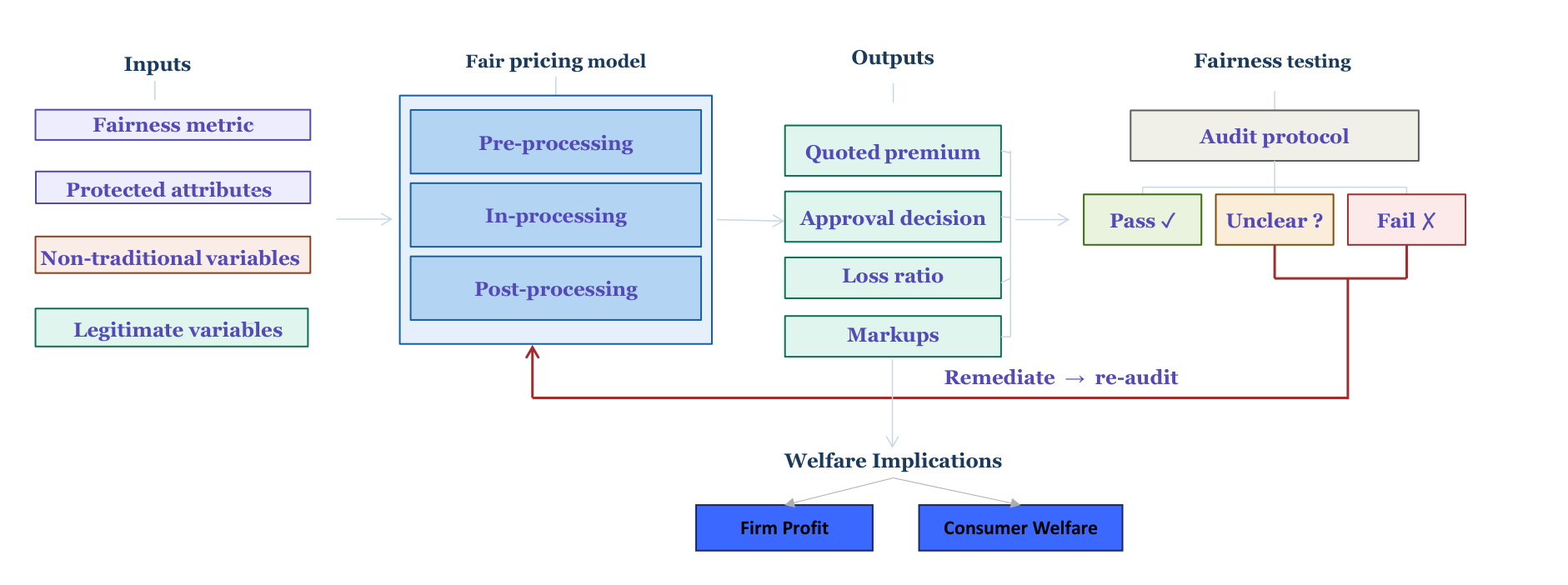
Pathway towards fairness from model inputs and design through outputs, welfare, and fairness testing to pass, unclear, or fail

The diagram shows how the four steps connect across model design, welfare assessment, and fairness testing.

What the research shows

Key findings from the research

On regulations and fairness criteria (Frees and Huang 2023; Xin and Huang 2024)

  • The regulatory spectrum runs from no regulation through prohibition on specific variables to community rating. Each level maps to a different fairness criterion and a different model design.
  • Fairness through unawareness (simply removing the protected attribute) is a common industry default but is not sufficient, and is not required by all fairness criteria. Some criteria explicitly use the protected attribute during training. Proxy effects also persist through correlated variables, and indirect discrimination can survive even rigorous data cleaning.
  • Six principles help classify whether a rating variable is appropriate for use. These are control, mutability, statistical discrimination, causality, history of past discrimination, and whether use inhibits socially valuable behaviour.

On model design (Xin and Huang 2024)

  • Four model families (MU, MDP, MCDP, and MC) implement four distinct fairness criteria: FTU, demographic parity (DP), conditional demographic parity (CDP), and controlling for the protected variable (CPV).
  • The fairness–accuracy trade-off is real but manageable. On a benchmark auto insurance dataset, fair models using XGBoost retained most predictive power while substantially reducing group premium disparities.
  • Addressing indirect discrimination through proxy removal (MCDP) reduces adverse selection risk more than simply excluding the protected attribute (MU).

On welfare (Huang, Shimao, and Khern-am-nuai 2026; Huang and Shimao 2026)

  • A fair cost model does not guarantee a fair outcome. Price optimisation, demand elasticity, and competitive dynamics can reintroduce group disparities after cost-level fairness is achieved.
  • Demographic parity on premiums (PDP) closes price gaps between protected groups but can simultaneously widen markup disparities, creating a new form of inequality even as it resolves the old one.
  • No single pricing rule achieves both price fairness and markup fairness at once. The paper characterises the trade-off and shows which regulatory approaches come closest for different market structures.

On auditing (Huang and Hooker 2026; Xin, Hooker, and Huang 2026, 2025)

  • Classical OLS standard errors are unreliable for auditing deterministic pricing algorithms. Heteroskedasticity-consistent HC3 standard errors are required for valid inference on conditional demographic parity.
  • A clean audit requires equivalence testing (TOST). A pass means positive evidence the disparity is within tolerance, not merely the absence of a statistically significant violation.
  • When race or ethnicity is inferred via BISG or BIFSG proxy methods, the resulting regression coefficient is not the same estimand as a true-group disparity. Audits using proxied race require additional corrections.
Step Key references
1 · Define fairness Frees and Huang (2023); Xin and Huang (2024); Krafcheck, Balnozan, and Huang (2026)
2 · Design fair pricing Xin and Huang (2024)
3 · Assess impact Huang, Shimao, and Khern-am-nuai (2026); Huang and Shimao (2026)
4 · Audit the system Huang and Hooker (2026); Xin, Hooker, and Huang (2026); Xin, Hooker, and Huang (2025)

End-to-end audit flow

Step 4 follows an integrated Plan, Audit, Decide, and Improve protocol (Huang and Hooker 2026). All design choices are fixed before examining data.
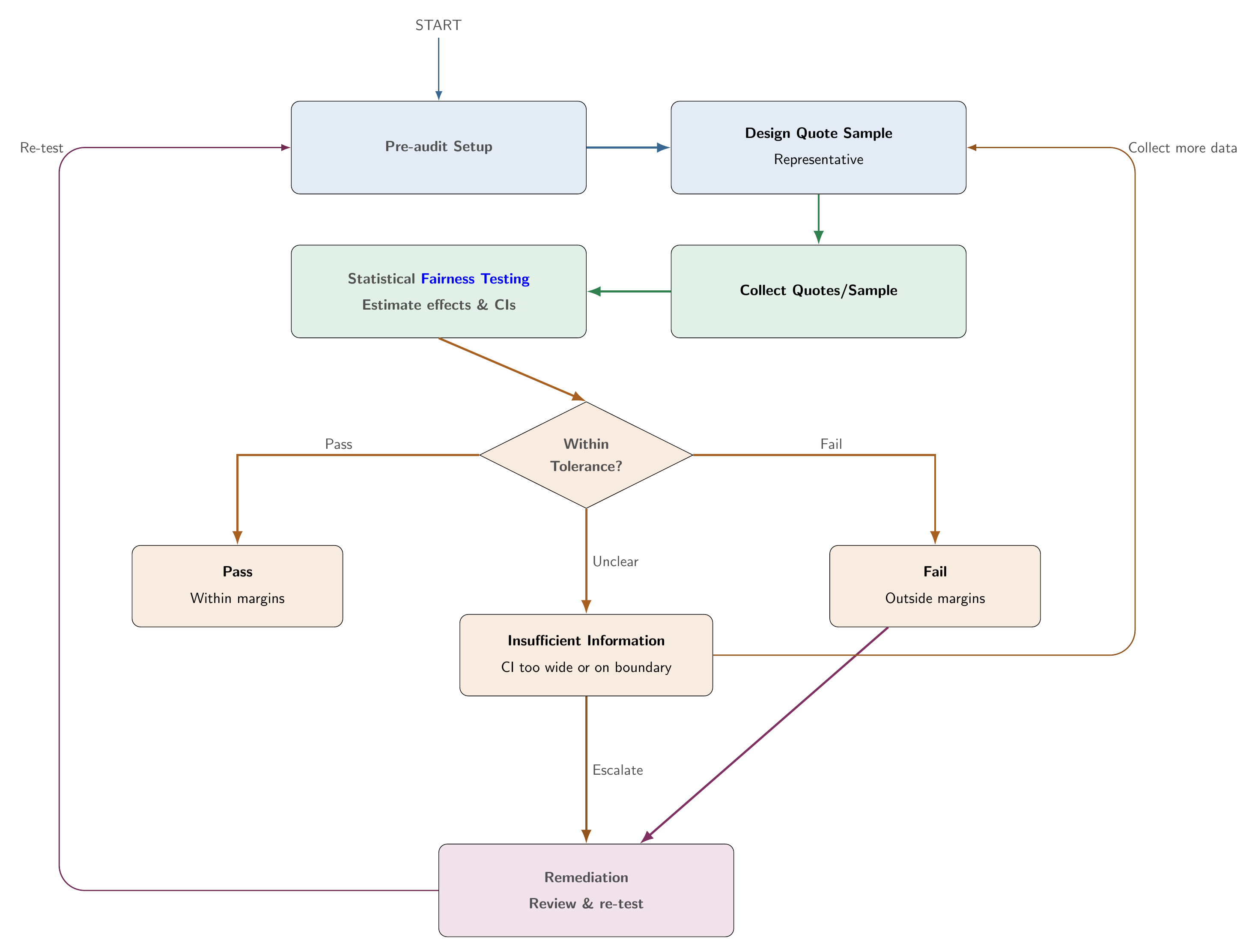
End-to-end fairness audit flow: Plan, Audit, Decide, Improve

Phase Actions
Plan Select criterion (PD or CDP), legitimate factors, tolerance bands, representative sample
Audit Collect prices and run statistical fairness tests with corrected inference
Decide Pass, insufficient information, or fail (equivalence testing)
Improve Remediate and re-test; collect more data if unclear

Full detail is in Step 4: Audit the system.

About the author

Get in touch

Firms, regulators, and policymakers who want to discuss fair pricing, audits, or policy applications are welcome to contact Dr Fei Huang.

Dr. Fei Huang

School of Risk and Actuarial Studies, UNSW Business School

Email: feihuang@unsw.edu.au · Website: feihuang.org

Dr. Fei Huang is an Associate Professor (with tenure) in Risk and Actuarial Studies at UNSW Business School. She holds degrees from Xiamen University (BSc), the University of Hong Kong (MPhil), and the Australian National University (PhD). Her research sits at the intersection of responsible AI, insurance, and data-driven decision-making, with emphasis on insurance and retirement systems that stay fair, sustainable, and resilient amid technological and climate change. She draws on statistics, machine learning, economics, and actuarial science to develop approaches that are accurate, interpretable, and equitable.

Her work has been recognised with awards including the Australian Business Deans Council Award for Innovation and Excellence in Research, the Dean’s Award for Distinction, the North American Actuarial Journal Best Paper Award, and the Actuaries Institute Volunteer of the Year Award, and is supported by competitive funding such as Australian Research Council Discovery Projects and the National Industry PhD Program. She is a columnist for Actuaries Digital, works with industry and government on topics from fair pricing to longevity and climate resilience, and has advised regulators internationally, including as an invited expert at the New York State Assembly public hearing on AI in insurance. At UNSW she teaches actuarial data science and responsible AI and has received multiple teaching excellence awards.

Acknowledgements

The author thanks Xi Xin for his support in preparing these materials, and acknowledges co-authors and collaborators Giles Hooker, Hajime Shimao, Warut Khern-am-nuai, Eric Krafcheck, and Igor Balnozan.

How to cite

To cite this playbook in academic work, use the APA format below.

Huang, F. (2026). The Fair Pricing Playbook: A practical framework for developing, evaluating, and auditing fair algorithmic pricing. SSRN. https://papers.ssrn.com/sol3/papers.cfm?abstract_id=6955039

BibTeX

@misc{huang2026fairpricingplaybook,
  title     = {The Fair Pricing Playbook: A practical framework for
               developing, evaluating, and auditing fair algorithmic
               pricing},
  author    = {Huang, Fei},
  year      = {2026},
  publisher = {SSRN},
  doi       = {10.2139/ssrn.6955039},
  url       = {https://papers.ssrn.com/sol3/papers.cfm?abstract_id=6955039}
}

Open source

This playbook is fully open source under CC BY 4.0. All source files — step pages, case study code, bibliography, and site configuration — are available at github.com/feihuangFH/fair-pricing-playbook.

You are free to fork the repository, adapt the framework for your own market or product, and reproduce or extend the case studies. Attribution is required.

License

Materials are licensed under CC BY 4.0. See LICENSE.

References

Frees, Edward W, and Fei Huang. 2023. “The Discriminating (Pricing) Actuary.” North American Actuarial Journal 27 (1): 2–24.
Huang, Fei, and Giles Hooker. 2026. “Fairness Testing for Algorithmic Pricing.” https://arxiv.org/abs/2605.11614.
Huang, Fei, and Hajime Shimao. 2026. “Welfare Implications of Fair and Accountable Insurance Pricing.” Journal of Risk and Insurance. https://doi.org/10.1111/jori.70051.
Huang, Fei, Hajime Shimao, and Warut Khern-am-nuai. 2026. “Do Fair Algorithms Improve Welfare? Evidence from the Insurance Market.” UNSW Business School Research Paper Forthcoming. https://doi.org/10.2139/ssrn.5112616.
Krafcheck, Eric, Igor Balnozan, and Fei Huang. 2026. “Fairness Metrics for Life Insurance.” Society of Actuaries Research Institute. https://www.soa.org/resources/research-reports/2026/fairness-metrics-life-insurance/.
Xin, Xi, Giles Hooker, and Fei Huang. 2025. “Pitfalls in Machine Learning Interpretability: Manipulating Partial Dependence Plots to Hide Discrimination.” Insurance: Mathematics and Economics 125: 103135. https://doi.org/10.1016/j.insmatheco.2025.103135.
———. 2026. “How Proxy Race Distorts Regression-Based Fairness Audits.” https://arxiv.org/abs/2603.17106.
Xin, Xi, and Fei Huang. 2024. “Antidiscrimination Insurance Pricing: Regulations, Fairness Criteria, and Models.” North American Actuarial Journal 28 (2): 285–319.